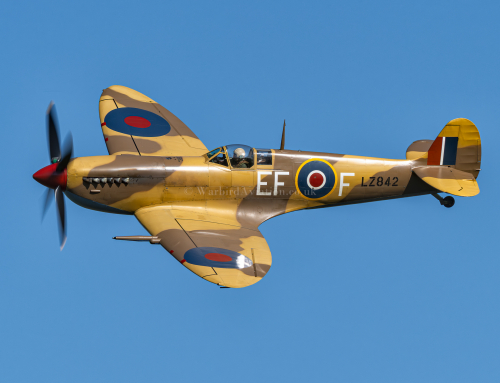
Supermarine Spitfire MK Vc G-IPSY EE602 | Fighter Aviation Engineering

- STATUS: Airworthy
- LOCATION: Duxford
- OWNER: Fighter Aviation Engineering
- ROLE: Fighter
- BUILT: 1942
- LENGTH: 9.95 m / 32 ft 8 in
- WINGSPAN: 11.23 m / 36 ft 10 in
- ENGINE: Rolls‑Royce Griffon 66
- MAXIMUM SPEED: 716 km/h / 446 mph
- RANGE: 1,400 miles (2,250 km) with external drop tanks
- ARMAMENT: 4 × .303 Browning machine guns + 2 × 20mm Hispano cannons
The Origins of Spitfire EE602
Built in 1942 at the height of the Second World War, this Mk.Vc variant went on to serve with three front‑line squadrons, escort one of the most famous bombers of the war, and eventually survive into the modern era as a beautifully restored flying warbird.
Today, EE602 is one of the most historically significant airworthy Spitfires, carrying the scars, stories, and spirit of the pilots who once depended on her.
EE602 rolled out of the Westland “Shadow Factory” in Yeovil on 11 September 1942, built under contract B124305/40
She was fitted with the universal “C‑wing”, capable of carrying a flexible mix of armament—machine guns, cannons, or both. EE602 flew with the mixed configuration: four .303 machine guns and two 20mm cannons
Originally powered by a Rolls‑Royce Merlin 46, she was later restored with a Rolls‑Royce Griffon 66.
Operational Service
EE602’s wartime career spanned three front‑line squadrons and reflected the full tempo of RAF fighter operations. She first joined No. 66 Squadron RAF, a seasoned Spitfire unit with Battle of Britain heritage, flying offensive sweeps and bomber escorts over occupied Europe. In February 1943, she transferred to 129 (Mysore) Squadron RAF, a unit partly funded by the Indian state of Mysore. It was during this period that EE602 took part in her most famous mission: escorting the B‑17 “Memphis Belle” on its 25th and final sortie on 17 May 1943. Her final wartime posting was with 453 Squadron (RAAF), where she continued operations across the Channel, including coastal patrols, anti‑shipping missions, and further escort duties.
Post‑war Life & Restoration
After the war, EE602 passed through storage, disposal, and eventually into civilian hands. She now flies under the registration G‑IBSY, operated and maintained by specialist warbird restoration group Fighter Aviation Engineering.
Photo Gallery