
Douglas C-47 Skytrain ‘Night Fright’ 2100521 | Charlie Walker

- STATUS: Airworthy
- LOCATION: Sywell Airfield, UK
- OWNER: Charlie Walker
- ROLE: Cargo
- BUILT: 1944
- LENGTH: 19.66 m 64 ft 5 in
- WINGSPAN: 28.96 m 95 ft 0 in
- ENGINE: 2 × Pratt & Whitney R-1830-92 Twin Wasp
- MAXIMUM SPEED: 224 mph (360 km/h)
- RANGE: 1,600 miles (2,575 km)
An Authentic Survivor of Allied Airborne Operations
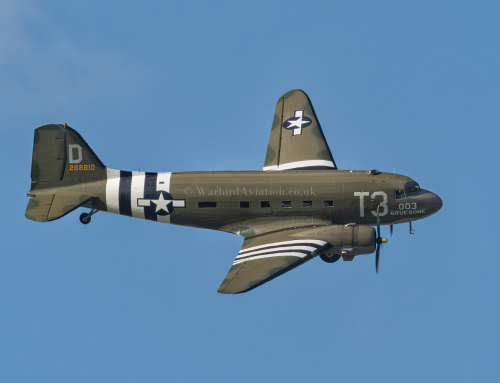
One of the world’s most authentic surviving D-Day veteran transport aircraft, Night Fright is a Douglas C-47 Skytrain restored to its exact June 1944 configuration. Built for the United States Army Air Forces, the aircraft served with the 79th Troop Carrier Squadron, 436th Troop Carrier Group, flying from RAF Membury in Berkshire during the Second World War.
Unlike many surviving C-47s that were rebuilt into post-war civilian transports, Night Fright has been painstakingly returned to her wartime appearance, preserving numerous original combat features and even evidence of battle damage repairs. The restoration has become one of Britain’s most ambitious historic aviation projects, with the aim of operating the aircraft as a flying memorial to the men and women of Troop Carrier Command.
Operational History
Night Fright participated in every major Allied airborne campaign in northwest Europe during 1944–45, including:
- Normandy landings
- Dropped paratroopers of the 101st Airborne Division during Operation Albany.
- Later towed gliders during Operation Elmira.
- Operation Dragoon
- Operation Market Garden
- Battle of the Bulge
- Delivered ammunition, food and medical supplies to surrounded Allied troops at Bastogne.
- Operation Varsity
Throughout the war the aircraft also:
- Towed assault gliders
- Evacuated wounded personnel
- Carried cargo and reinforcements
- Returned prisoners of war and casualties from the front.
Combat Record
During one of its D-Day missions, Night Fright reportedly sustained more than 100 hits from German anti-aircraft fire yet returned safely to England. Although heavily damaged, repairs allowed the aircraft to return to operational service within days.
Restoration
After military and civilian service following the war, the aircraft was eventually discovered stored at Walnut Ridge, Arkansas, in 2012. Originally intended for static display, the project evolved into a complete flying restoration.
The aircraft was transported to the United Kingdom in 2016, where an extensive restoration sought to recreate every detail of its wartime configuration—from troop seats and radio equipment to invasion stripes and authentic squadron markings. Much of the work focused on preserving original components rather than replacing them wherever possible.
Following more than a decade of painstaking restoration, Night Fright returned to flight in June 2026, bringing one of Britain’s most significant historic aviation projects to a successful conclusion. Every stage of the restoration was carried out with authenticity in mind, from the aircraft’s wartime cockpit layout and radio equipment to its troop compartment, invasion stripes and period markings. Wherever possible, original components were restored rather than replaced, preserving the aircraft’s remarkable wartime character and making her one of the most authentic flying C-47s in the world.
The aircraft’s departure from Coventry Airport marked the end of an extraordinary chapter. Having spent years in restoration, the successful first flight was a fitting reward for the dedicated team whose expertise and determination had transformed a long-term project into a fully airworthy D-Day veteran once again.
Following its return to the skies, Night Fright relocated to its temporary home at Sywell Aerodrome in Northamptonshire. From there, the aircraft will commence its post-restoration flying programme. The long-term ambition remains for Night Fright to become a centrepiece of a permanent heritage operation, ensuring this remarkable C-47 continues to educate and inspire future generations while honouring those who served.
Photo Gallery




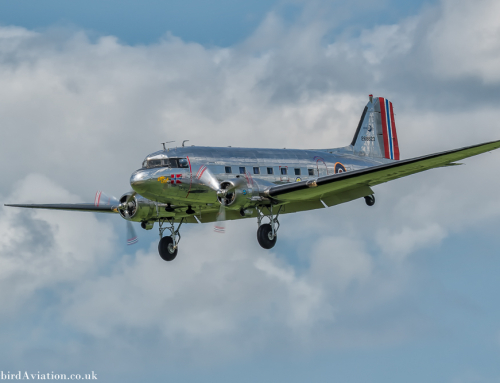
 Douglas C-53D-DO Dakota Little Egypt (LN-WND)


