Tactical Leadership Programme —
Inside Europe’s Premier Advanced Air-Combat School
The Tactical Leadership Programme is an international military organisation founded to train the next generation of mission leaders for NATO and allied air forces. Its goal isn’t just to teach pilots how to fly, but how to lead. That means preparing aircrews to plan, coordinate, and execute complex Composite Air Operations (COMAO): missions involving dozens of aircraft across multiple roles — fighters, tankers, AWACS, helicopters, drones, electronic-warfare platforms, and more. The TLP began in the 1970s and has since evolved into a core element of NATO’s high-end training ecosystem. It is currently based at Albacete Air Base, Spain, where the surrounding airspace and ranges allow for large-scale, multi-platform mission profiles.

Spanish Navy McDonnell Douglas EAV-8B Matador II VA.1B-39/01-927 departing Albacete Los Llanos Air Base during TLP 25-4

French Air Force Dassault Mirage 2000-5F 65/2-MG departing Albacete Los Llanos Air Base during TLP 25-4
The flying program runs 3 or 4 times a year after two weeks of intense classroom and simulator training with the 2025-04 course running from 6 to 28 November 2025, with the live flying phase scheduled 17 November to 28 November. Around 550 personnel were on base for this course; 38 of them will graduate — among them 26 aircrew (pilots), 6 intelligence officers, and 6 tactical-air controllers (GCI). The live flying portion involves roughly 40 aircraft from multiple nations.
Who participated — aircraft & nations
Blue Air (Friendly / Allied Forces)
Blue Air deployed about 20 aircraft from various air forces.
- Italy — Eurofighter Typhoons

Italian Air Force Eurofighter F-2000A Typhoon MM7317/4-43 landing at Albacete Los Llanos Air Base during TLP 25-4

Italian Air Force Eurofighter F-2000A TyphoonMM7290/36-22 landing at Albacete Los Llanos Air Base during TLP 25-4
- Spain — Eurofighter and AV-8 Harriers aircraft

Spanish Air Force Eurofighter EF-2000 C.16-66 / 14-66 landing at Albacete Los Llanos Air Base during TLP 25-4. The special tail celebrates 50 years of Ala 14

Spanish Navy McDonnell Douglas EAV-8B Matador II VA.1B-37/‘01-925’ landing at Albacete Los Llanos Air Base during TLP 25-4

Spanish Navy McDonnell Douglas EAV-8B Matador II VA.1B-39/01-927 landing at Albacete Los Llanos Air Base during TLP 25-4

Romanian Air Force General Dynamics F-16AM Fighting Falcon 1609’ landing at Albacete Los Llanos Air Base during TLP 25-4

Romanian Air Force General Dynamics F-16AM Fighting Falcon 1607 landing at Albacete Los Llanos Air Base during TLP 25-4

Romanian Air Force General Dynamics F-16AM Fighting Falcon 1607 departing Albacete Los Llanos Air Base during TLP 25-4

Romanian Air Force General Dynamics F-16AM Fighting Falcon 1609 landing at Albacete Los Llanos Air Base during TLP 25-4

Turkish Air Force General Dynamics F-16C Fighting Falcon 90-0010 landing at Albacete Los Llanos Air Base during TLP 25-4

German Air Force Panavia Tornado IDS 45+92 landing at Albacete Los Llanos Air Base during TLP 25-4

German Air Force Panavia Tornado IDS 45+92 landing at Albacete Los Llanos Air Base during TLP 25-4

German Air Force Panavia Tornado IDS 44+58 landing at Albacete Los Llanos Air Base during TLP 25-4
- France — Mirage 2000D / 2000-5F

French Air Force Dassault Mirage 2000-5F ’59 / 2-EV Triple Stark Tail landing at Albacete Los Llanos Air Base during TLP 25-4

French Air Force Dassault Mirage 2000D 626/3-IC departing Albacete Los Llanos Air Base during TLP 25-4
French Air Force Dassault Mirage 2000-5F 67/‘2MH’ landign at Albacete Los Llanos Air Base during TLP 25-4
Red Air (Opposing / Aggressor Forces)
To simulate realistic opposition — Red Air fields a smaller, but capable force.
- France — Mirage 2000D / 2000-5F

French Air Force Dassault Mirage 2000D 658/3-JN departing Albacete Los Llanos Air Base during TLP 25-4
French Air Force Dassault Mirage 2000-5F 58/‘2-EL’ landing at Albacete Los Llanos Air Base during TLP 25-4
French Air Force Dassault Mirage 2000D 682/‘3-JR’ departing Albacete Los Llanos Air Base during TLP 25-4
- Spain — Eurofighter and F-18s

Spanish Air Force Eurofighter EF-2000 C.16-73/‘14-73’ Tiger Tail landing at Albacete Los Llanos Air Base during TLP 25-4

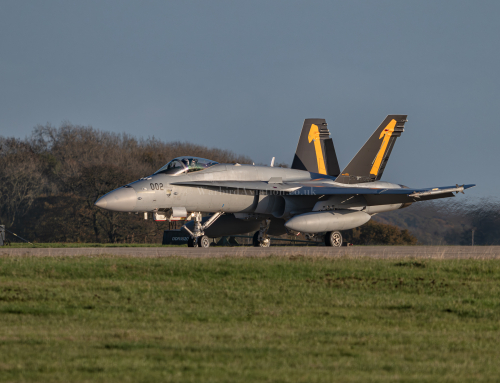
Spanish Air Force McDonnell Douglas EF-18M Hornet C.15-69/12-27 landing at Albacete Los Llanos Air Base during TLP 25-4

Spanish Air Force McDonnell Douglas EF-18M Hornet C15-6112-61 landing at Albacete Los Llanos Air Base during TLP 25-4
- Turkey — F-16 Fighting Falcons

Turkish Air Force General Dynamics F-16D Fighting Falcon 88-0014 landing at Albacete Los Llanos Air Base during TLP 25-4

Turkish Air Force General Dynamics F-16C Fighting Falcon 90-0004 landing at Albacete Los Llanos Air Base during TLP 25-4
Support, Drones, EW & Command/Control Assets
To replicate real-world complexity:
- NATO AWACS (airborne early warning & command) controlling mission traffic.

NATO Airborne Early Warning & Control Force Boeing E-3A Sentry LX-N90453 departing Albacete Los Llanos Air Base during TLP 25-4
- Spanish drone asset — an MQ-9 Predator B — for ISR (reconnaissance / intelligence).
- Helicopters (e.g. Spanish NH-90) for Combat Search & Rescue (CSAR) or support roles.
- Electronic-warfare / threat simulation assets — including ground-based air defence systems from Spanish Army/air force (e.g. NASAMS, SKYGUARD, MISTRAL), plus simulated threats via foreign-provided systems/ground-to-air batteries.
- Italian Spartan C-27J as a slow mover
- Support and transport aircraft

Italian Air Force C-27J Spartan MM62214/46-84 landing at Albacete Los Llanos Air Base during TLP 25-4

German Air Force Lockheed Martin C-130J Super Hercules 55+06 landing at Albacete Los Llanos Air Base during TLP 25-4
Morning Wave
Morning flying kicked off each day around 10am with just the French Mirages going out and returning around 11:30. There was also local action from the based EF2000, Northrop SF-5M Freedom Fighter and visiting Pilatus PC-21 from San Javier Air Base dropping in on several days to perform low (and often not so low) passes and circuits.

Spanish Air Force Northrop SF-5M Freedom Fighter 23-07 departing Albacete Los Llanos Air Base

Spanish Air Force McDonnell Douglas F/A-18A+ Hornet C.15-77/46-05 departing Albacete Los Llanos Air Base for Grando.

Spanish Air Force Eurofighter EF-2000 Typhoon C.16-4514-45 performing touch and goes at Albacete Los Llanos Air Base.
Afternoon Composite Air Operations (COMAO) missions
The main Composite Air Operations (COMAO) missions started around 1:30pm with the launch of the NATO Airborne Early Warning & Control Force Boeing E-3A Sentry, taking up position over the ocean to the south east for the first two days working for Red Air before switching to just east of Madrid for the remainder of the exercise working for blue air. A French MRT also supported red air operating from its base at Air Force Base 125 in Istres, near Marseille.

French Air Force Dassault Mirage 2000D 657/3-JM landing in some fantastic evening light at Albacete Los Llanos Air Base during TLP 25-4

French Air Force Dassault Mirage 2000D 658/3-JN landing at Albacete Los Llanos Air Base during TLP 25-4

German Air Force Panavia Tornado IDS 44+34 landing at Albacete Los Llanos Air Base during TLP 25-4

Spanish Air Force Eurofighter EF-2000 Typhoon C.16-7714-77 performing touch and goes at Albacete Los Llanos Air Base.

Spanish Air Force McDonnell Douglas EF-18M Hornet C15-5912-17 landing at Albacete Los Llanos Air Base during TLP 25-4

French Air Force Dassault Mirage 2000-5F 65/2-MG landing at Albacete Los Llanos Air Base during TLP 25-4
The main fighter launch started about 3:30pm with around 28 aircraft taking to the skies over the 40mins or so before a dash to the eastern approaches to capture the aircraft returning. With sunset at 17:50 locally and the missions due to finish at 17:30 it would have been a struggle to capture them all in good light but each day we were blessed with an early finish and some stunning late afternoon winter light as they started to return from around 16:40 and were all, with the exception of the AWACS and Learjet, back on the ground by 17:30.

French Air Force Dassault Mirage 2000-5F 65/2-MG landing at Albacete Los Llanos Air Base during TLP 25-4
French Air Force Dassault Mirage 2000D 634/‘3-JE’ landing at Albacete Los Llanos Air Base during TLP 25-4
German Air Force Panavia Tornado IDS 44+58 landing at Albacete Los Llanos Air Base during TLP 25-4

Spanish Navy McDonnell Douglas EAV-8B Matador II VA.1B-37-‘01-925’ landing at Albacete Los Llanos Air Base during TLP 25-4
French Air Force Dassault Mirage 2000D 682/‘3-JR’ landing at Albacete Los Llanos Air Base during TLP 25-4




Feel free to add a comment