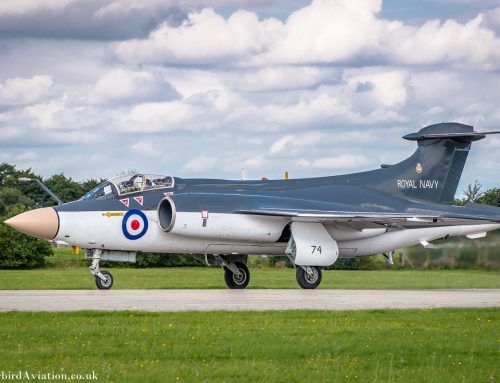
Blackburn Buccaneer S.2B XX894 | The Buccaneer Aviation Group

- STATUS: Ground Running
- LOCATION: Cotswold Airport, Gloucestershire
- OWNER: The Buccaneer Aviation Group
- ROLE: Maritime strike aircraft
- BUILT: 1974
- LENGTH: 19.33 m (63 ft 5 in)
- WINGSPAN:
- ENGINE: 2 × Rolls‑Royce RB.168 Spey Mk.101 turbofans
- MAXIMUM SPEED: 670 mph, 1,070 km/h Mach 0.95
- RANGE: 2,300 mi, 3,700 km
Aircraft History
Blackburn Buccaneer S.2B XX894 is one of the most historically significant surviving Buccaneers, representing nearly two decades of RAF strike operations across Europe, the United States, and the Middle East. Delivered to the RAF in the mid‑1970s, she served with multiple front‑line squadrons, took part in major NATO exercises, conducted weapons trials, and ultimately flew operationally during the first Gulf War before retirement in 1994.
Today, XX894 is preserved in fast‑taxiable condition by The Buccaneer Aviation Group at Cotswold Airport, where she remains one of the finest running examples of the type.
RAF Service (1975–1990)
Buccaneer S.2B XX894 was delivered to the Royal Air Force around 1974 as a purpose‑built RAF strike aircraft, not a conversion from a former Royal Navy airframe. She entered Royal Air Force service in December 1975, joining 16 Squadron at RAF Laarbruch during a period when the Buccaneer formed the backbone of the RAF’s low‑level strike capability in Germany. She later transferred to 15 Squadron, taking part in major NATO deployments including Red Flag 1980 in the United States. This was a pivotal exercise for the Buccaneer force, marked by the loss of sister aircraft XV345 and the subsequent temporary grounding of the fleet.
In 1981, XX894 was assigned to the Aeroplane & Armament Experimental Establishment (A&AEE) at Boscombe Down for trials work before returning to front‑line duties later that year with 12 Squadron at RAF Lossiemouth. With 12 Squadron she participated in Operation Western Fox in Florida, where she conducted rare live firings of Martel anti‑ship missiles against retired naval vessels.
Through the late 1980s and early 1990s, XX894 served with both 208 Squadron and 237 Operational Conversion Unit, continuing in the maritime strike and training roles as the Buccaneer fleet consolidated at Lossiemouth. During this period she wore several notable schemes, including the distinctive grey finish with a green‑and‑black fuselage flash marking 12 Squadron’s 75th anniversary.
Gulf War Service – Operation Granby (1991)
XX894 saw active service during the first Gulf War, operating as part of the RAF’s low‑level strike and laser designation force in Operation Granby. Buccaneers played a crucial role in providing laser guidance for Tornado GR.1s, and XX894 contributed to this historic final combat chapter of the type.
Final RAF Flight & Retirement (1994)
XX894’s final operational sortie took place on 29 March 1994, flown by Flt Lt Steve Reeves with navigator Flt Lt Neil Devine. The aircraft made a low, photogenic pass along the Lossiemouth runway before departing south for its final tactical mission
She was retired shortly afterwards and flown to RAF St Athan for disposal in April 1994
Preservation & Restoration
Bruntingthorpe Era (1994–2020)
After retirement, XX894 was acquired for preservation at Bruntingthorpe, where she underwent extensive restoration to fast‑taxiable condition; engine runs began in 2004, and her wings, brakes, and hydraulic systems were progressively restored, ultimately enabling her to perform regular public fast‑taxi demonstrations.
The Buccaneer Aviation Group – Cotswold Airport (2020–Present)
Following the closure of public operations at Bruntingthorpe, XX894 moved to Cotswold Airport, where she is maintained by The Buccaneer Aviation Group. She remains fully operational for ground runs and is still capable of performing wing‑fold and hydraulic demonstrations, making her one of the most complete and active Buccaneers in existence.
Photo Gallery